
Codex + GPT-5.5: A Practical System Overview
A source-bounded reconstruction of how Codex can become a reliable delivery system through context, skills, permissions, parallel work, and verification.
Source scope
The recurring themes are skills configuration, plugins, research tasks, automation, parallel work, and combining those capabilities into a durable development system.
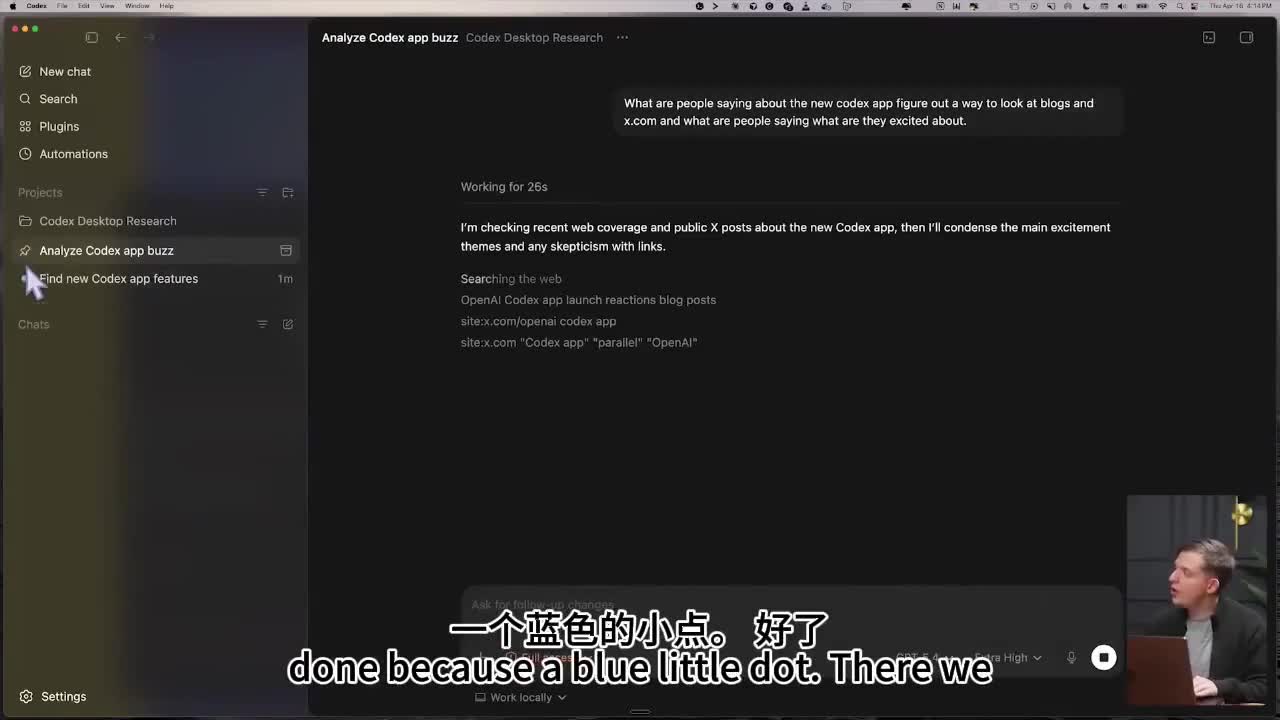
Reference video
The embedded video is the public source used for this series. Use it alongside the screenshots and chapter notes.
Core method
This is not simply a prompt followed by an answer. First define the context, reusable skills, permissions, external tools, automation boundaries, and verification requirements; then let the model execute.
Define the working method
Turn experience into skills
Run research and production together
Make results verifiable
System layers
| Layer | Visible form | Purpose |
|---|---|---|
| Context | Research conversations, project background, goals, and location | Reduce the problem space and establish the working environment. |
| Capability | Skill management, creation, and reusable workflows | Turn experience and conventions into durable assets. |
| Execution | Parallel tasks, worklogs, research, automation, and code changes | Advance multiple deliverables without manual turn-by-turn switching. |
| Verification | Builds, resource fixes, simulator checks, and final artifacts | Ensure results are real and usable rather than merely plausible. |
How to use this series
Read the companion articles in this order: skills and context engineering, plugins and research workflows, parallel execution and automation, then project-factory delivery.
Suggested reading order
Continue with skills and context engineering, then use the previous and next links at the bottom of each page.